How do you choose the right door closer?
How do you choose the right door closer?
Choosing the right door closer is important to ensure a door that closes safely, smoothly and in a controlled manner. The wrong model can result in poor function, unnecessary wear and tear or a door that does not close properly. In this guide, we will go over what you need to consider when choosing a door closer for exterior door, interior door, entrance door, fire door or double door.
The most important thing is to start from door type, door width, closing force, arm type and any fire requirements. Once you have these points in mind, it will be much easier to find the right model.
See all complete door closers here
1. Start by checking what type of door you have
The first step is to look at the door environment in which the door closer will be used. Different doors have different requirements for function, strength and installation.
- Inner door: often lower strength requirements, but smooth and quiet closing is important
- Front door or entrance door: often requires more powerful door closers because the door can be heavier and affected by wind and temperature
- Fire door: requires approved solutions and the correct function so that the door always closes correctly
- Double door: often requires a special double door set or coordinator so that the door leaves close in the correct order
If you are unsure, it is always best to start by identifying whether it is a regular single door or a double door, and whether there are fire rating requirements.
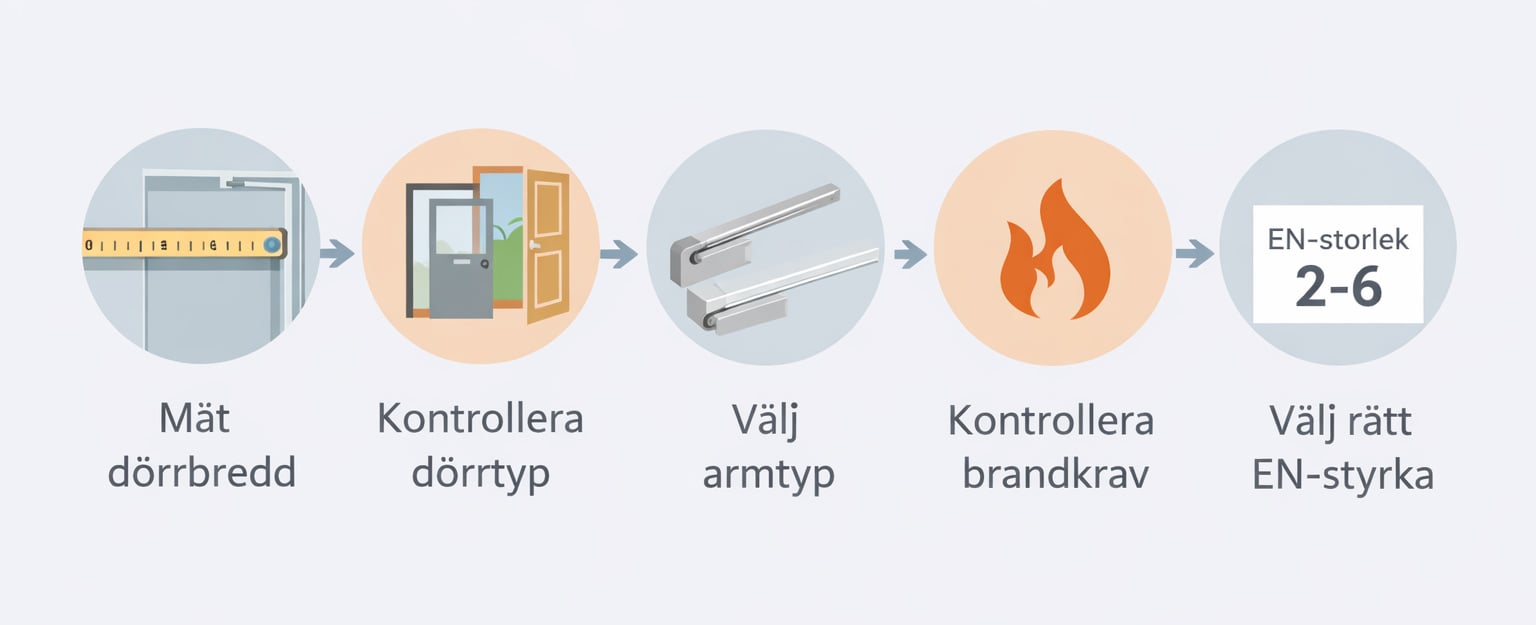
2. Check the door width and approximate weight
Door closers are often chosen based on door width, because the width in practice says a lot about how strong the door closer needs to be. The wider and heavier the door, the higher the closing force normally required.
When looking at a door closer, you should therefore always check:
- max door width
- what EN size the model has
- whether the model is intended for lighter or heavier door environments
For standard interior doors, a lighter model is often sufficient, while exterior doors, entrance doors and heavier property doors often require higher closing force.
3. Understand what EN size means
EN size indicates the closing force of the door closer. A higher EN size usually means that the door closer can handle wider or heavier doors.
Many modern door closers have adjustable closing force, for example:
- EN 1-4 for lighter door environments
- EN 2-5 for many common door types
- ONE 3-6 for heavier doors and more demanding environments
- EN 1-6 or EN 2-6 for models with larger adjustment range
The important thing is not to choose the highest possible strength just for safety reasons. A door closer that is too strong can provide unnecessarily high opening resistance. The goal is to choose a model that suits the size and use of the door.
4. Choose the right arm type
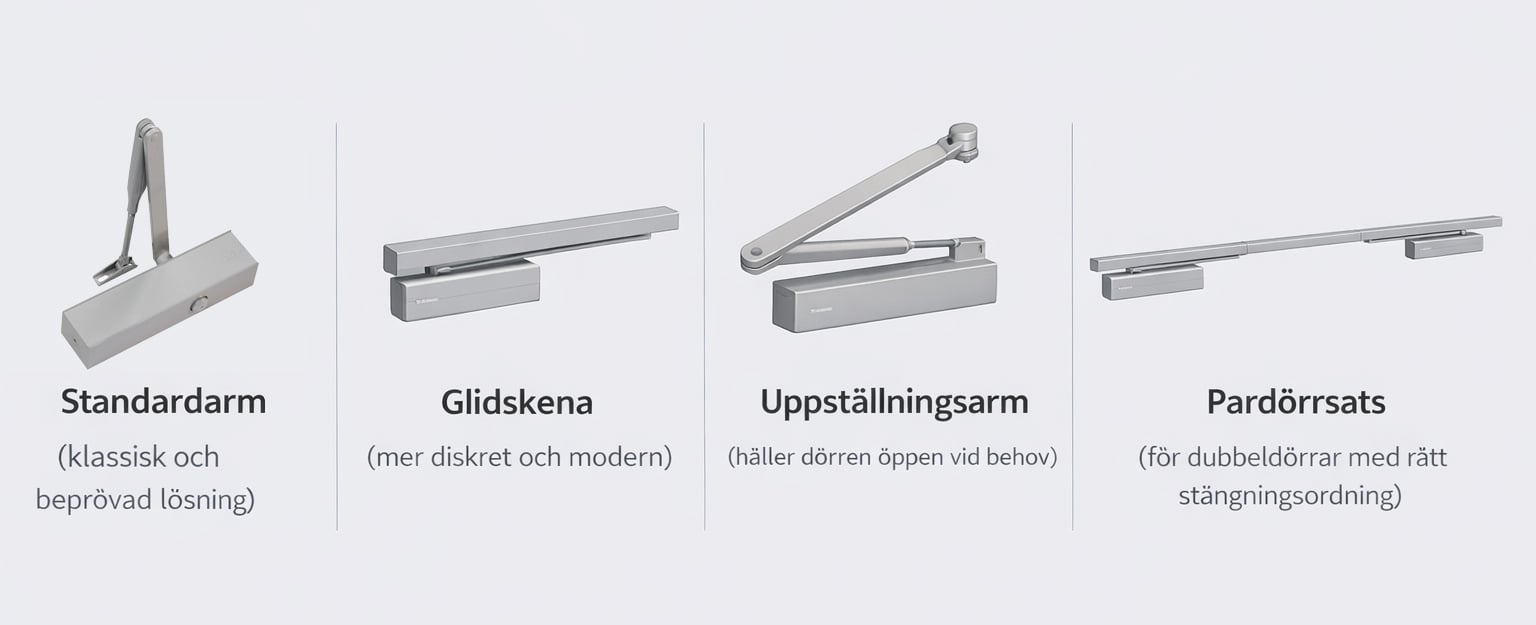
One of the main differences between different door closers is the type of arm system they have. Here are the most common options:
Standard arm
Standard arm is the classic solution. It is well-proven, robust and common on many types of doors. It is suitable when function is more important than a discreet appearance.
Sliding rail
The slide rail provides a more discreet and modern look than a standard arm. Many also find it to be a more attractive alternative in public environments, entrances and modern properties.
Stand-up arm
A stand-up arm allows the door to be held in the open position when needed. This can be practical in areas such as rooms, passages and environments where you sometimes want the door to be open. However, it is important to check what applies to fire doors, as the stand-up function may not always be used there.
Double door set
For double doors, a special solution with a coordinator or adapted slide rail is often needed so that the door leaves close in the correct order. This is especially important in fire-rated door environments.
5. Check how the door closer is to be mounted
Not all door closers are mounted the same way. Some models are designed for mounting on door leaf hinge side and frame stop side, while others can also be used in more assembly designs.
It is therefore important to check:
- whether the door closer should be mounted on the door leaf or frame
- whether it should be mounted on the hinge side or the stop side
- if the model requires special accessories for certain installations
If you are replacing an existing door closer, it is also a good idea to check how the old model is mounted before ordering a new one.
6. Consider fire and safety requirements
If the door is located in a fire compartment boundary or has a fire rating, you must check that the door closer is approved for this. This is especially true if you are considering a model with a stand-up function, double door coordinator or special accessories.
Important questions to check:
- Is the door closer approved for fire doors?
- may the selected arm type or stand-up function be used on a fire door
- Need a coordinator or special solution for double doors?
With fire doors, it is particularly important that the door can always close correctly and that the correct components are used.
7. When is a more powerful model better suited?
A more powerful door closer is often better suited when:
- the door is wide or heavy
- the door is used frequently during the day
- the door is located in the entrance or exterior wall
- the environment places higher demands on sustainability and safe function
For lighter interior doors, however, the strongest model is not always needed. In such cases, a lighter door closer can provide better comfort and lower opening resistance.
8. Feel free to choose a complete set
For most people, it is easiest to choose one complete door closer. Then the door closer housing and arm system are included in the same package, which makes the choice easier and reduces the risk of incorrect combinations.
It is often both easier and more affordable than buying the parts separately, especially if you want a solution that is directly suitable for the door environment.
See our range of complete door closers
Frequently asked questions about door closers
Which door closer is best suited for an exterior door?
It depends on the width, weight and how exposed the door is. For exterior doors, a stronger model is often needed than for regular interior doors.
What is the difference between standard arm and slide rail?
Standard arm is a classic and robust solution. Sliding rail usually gives a more discreet and modern look.
Can you use a stand-up arm on a fire door?
It depends on the solution and the door's requirements. In many cases, a standard stand-off arm cannot be used on a fire door, so this must always be checked before purchase.
When do you need a double door set?
If you have a double door where the door leaves must close in the correct order, a double door set or coordinator is often needed.
Summary
To choose the right door closer, you should start by checking door type, door width, closing force, arm type, installation and any fire requirements. When you have a handle on these points, it becomes much easier to find a model that works well in practice and lasts over time.
If you are unsure, a good first step is to compare different complete models and choose a solution where the right parts are already included.
Do you need a complete door closer?
See our range of models for exterior doors, interior doors, fire doors and double doors.
See all door closers here →
Recommended products
-
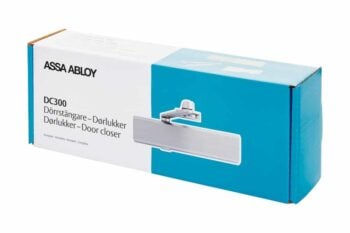
ASSA ABLOY DC300 Door Closer – Complete Kit (Package) – EN 3-6 – Standard Arm L190 – Silver
1295,00 kr -
ASSA ABLOY DC700 Door Closer – Complete Kit (Package) – EN 3-6 – Slide G195 – Silver
2489,00 kr -
Dormakaba TS83 Door Closer – Complete Kit – EN 3-6 – Standard Arm CL‑N – Silver
1131,00 kr -
GEZE TS5000 Door Closer – Complete Kit – EN 2-6 – Reinforced Slide Rail – Silver
3424,00 kr