How should you think when you set up your new Smart Home?
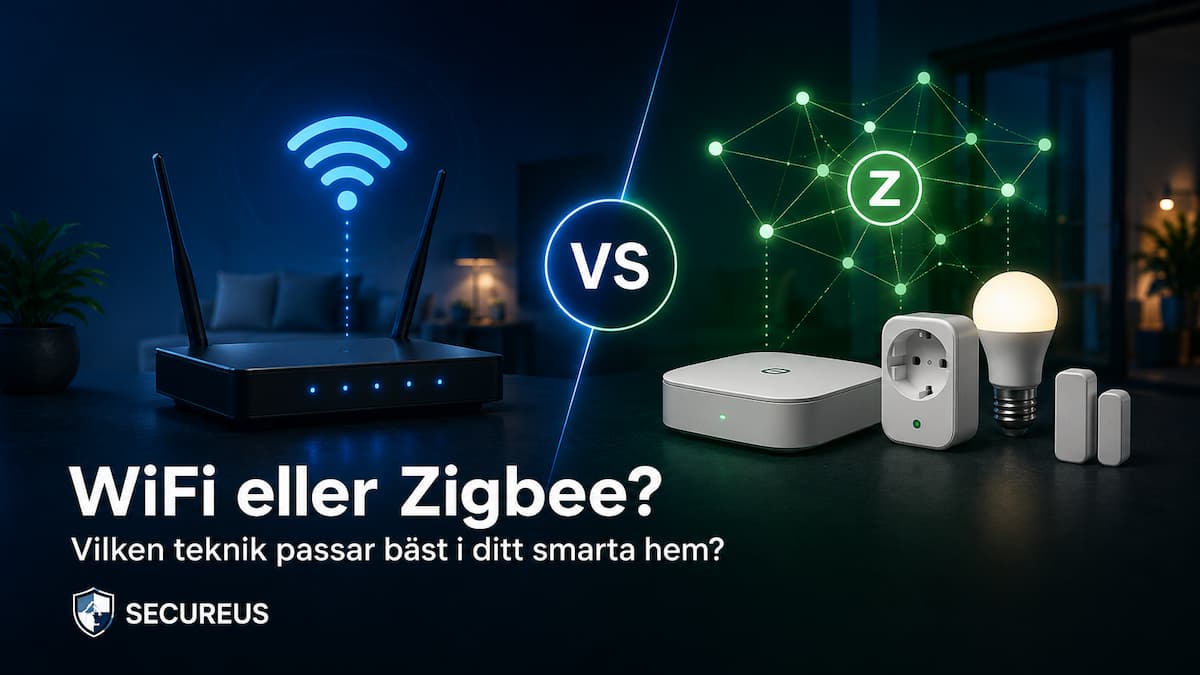
When building a smart home, one of the most common questions is whether to choose WiFi or Zigbee. Both technologies work with Stonehouse Smart, but they suit different needs depending on the size of the system you want to build.
The simple answer: WiFi is often best for easy installation and products like cameras, relays, and energy meters. Zigbee is best when you want to build a stable smart home with many sensors, long battery life, and better range over time.
🌐 What is WiFi?
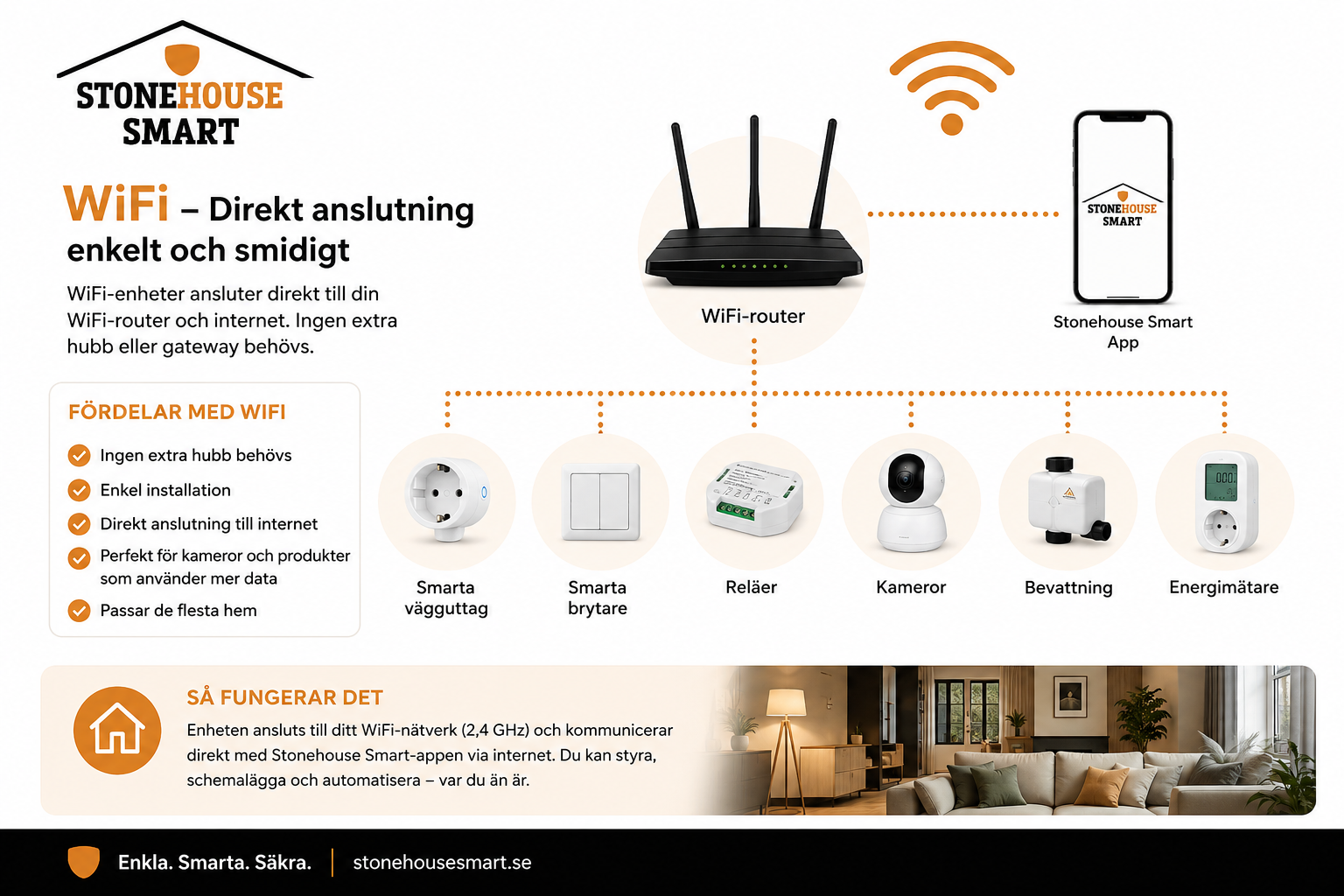
WiFi devices connect directly to your home wireless network. They do not need an extra gateway or hub; they communicate directly with your WiFi router and the internet.
Advantages of WiFi
- No extra hub is needed
- Simple installation
- Direct connection to the internet
- Perfect for smaller installations
- Good for cameras and products that use more data
Suitable for
- Smart relays
- Wall outlet
- Dimmers
- Cameras
- Irrigation systems
- Energy meter
- Lighting
📡 What is Zigbee?

Zigbee is a wireless system developed for smart homes. Unlike WiFi, Zigbee devices do not connect directly to your router. Instead, they connect to a Zigbee Gateway, also known as a hub or central unit.
Advantages of Zigbee
- Own mesh network
- Very stable communication
- Long battery life for sensors
- Less strain on your WiFi
- The network gets stronger as you expand it
Suitable for
- Door contacts
- Motion sensors
- Temperature and humidity regulators
- Water leakage sensors
- Smart buttons
- Sirens
- Automation systems
🕸️ This is how Zigbee Mesh works
What makes Zigbee extra smart is that the technology builds a Mesh network. Many fixed Zigbee devices act as signal amplifiers and send the signal on to the next device.
|
WiFi router
|
Stonehouse Smart Zigbee Gateway
|
Relay in the hall
|
Wall outlet in the kitchen
|
Dimmer in the living room
|
Temperature sensors in the garage
In this example, the temperature sensor in the garage does not need to be in direct contact with the gateway. The signal can be forwarded through other Zigbee devices in the home.
📶 Range and stability
The range is always affected by walls, concrete, metal and other obstacles. As a rough guideline, you can expect 10 to 25 meters indoors between two Zigbee devices and up to approximately 100 meters outdoors in open space.
Zigbee therefore fits very well in larger villas, garages, storage rooms, offices, warehouses and several buildings on the same plot of land.
🔌 Which Zigbee devices strengthen the network?
In general, most Zigbee devices powered by 230V function as repeaters. This means that they help to expand the network.
Can often function as a repeater
- Relay modules
- Smart wall outlets
- Dimmers
- Wall switch
Does not normally function as a repeater
- Door contacts
- Motion sensors
- Temperature sensors
- Water leakage sensors
- Smart buttons
🔋 Why does Zigbee have long battery life?
A Zigbee sensor is in sleep mode almost all the time and only wakes up when it needs to send information. This can be when a door opens, motion is detected, the temperature changes, or a water leak is detected.
This means that many Zigbee sensors can operate for a very long time on a single battery.
✅ When should you choose WiFi?
- You want to get started quickly
- You have a smaller number of smart products
- You have good WiFi coverage at home
- You don't want to install any gateway
- You should use cameras, sensors, irrigation systems or energy meters
✅ When should you choose Zigbee?
- You are planning a larger smart home
- You want to use many battery-powered sensors
- You want to reduce the load on your WiFi
- You want stable communication and quick response
- You want to be able to expand the system over time
🏠 WiFi and Zigbee work best together
You don't need to choose just one technology. In many smart homes, the best solution is to combine WiFi and Zigbee.
WiFi is often best suited for
- Cameras
- Smart relays
- Wall outlet
- Dimmers
- Irrigation systems
- Energy measurement
Zigbee is often best suited for
- Door contacts
- Motion sensors
- Temperature and humidity regulators
- Water leakage sensors
- Smart buttons
- Sirens
All products can be controlled from the same Stonehouse Smart app, regardless of whether they use WiFi or Zigbee.
📊 WiFi or Zigbee? A quick comparison
⭐⭐ Stonehouse Smart recommends
For smaller installations with a few smart products, WiFi is often the easiest choice.
If you want to build a complete smart home with many sensors, automation, and future expansion, we recommend that you supplement it with a Stonehouse Smart Zigbee Gateway. You get a stable Mesh network, long battery life for the sensors, and a system that gets better the more Zigbee devices you add.
The best part is that you don't have to choose one technology over the other. With Stonehouse Smart, WiFi and Zigbee products can work together in the same app.
Explore Stonehouse Smart at Secureus.se
At Secureus.se you will find a growing range of smart products for home, villa, office and small businesses.
🌐 WiFi products
For those who want to get started quickly. The products connect directly to your WiFi and do not require a gateway.
📡 Zigbee products
For those who want to build a stable smart home with Mesh networks, long battery life, and smart automation features.
🏡 All smart home products
Explore the entire range of sensors, relays, gateways, cameras, lighting, energy measurement and automation devices.